
When “Three’s Not a Crowd”
January 20, 2026
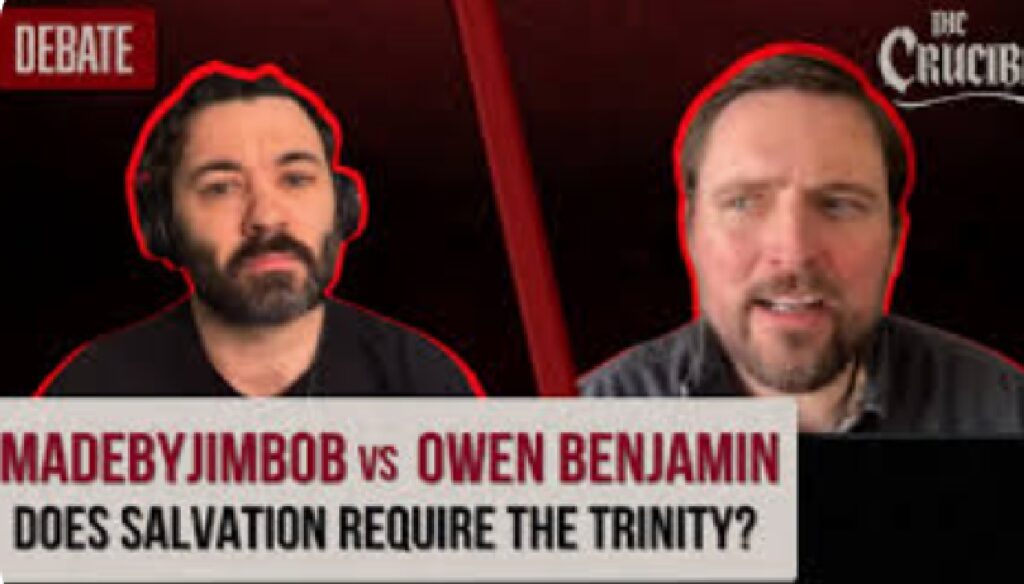
Trinity Debate Open
January 20, 2026Trinity Mystery Logic Problem

There is no adequate biblical evidence that Jesus is God. On the contrary, the doctrine of the Trinity contradicts the explicit words of Jesus and violates basic logic—something God Himself established. The Son of God consistently identifies the one God as distinct from himself:
“You believe in God; believe also in me.” (John 14:1b)
“The Father is greater than I.” (John 14:28)
“The Father is the only true God, and Jesus Messiah is the one he sent.” (John 17:3)
“I am ascending to my Father and your Father, and to my God and your God.” (John 20:17)
All these sayings from the favorite Trinitarian Gospel of John, no less!
Trinitarian theology asserts that there is exactly one God while simultaneously claiming that the Father, Son, and Holy Spirit are each fully God and yet genuinely distinct. This is not biblical monotheism; it is a logical contradiction and destruction of simple math. Scripture never defines God as “three persons in one essence.” Instead, it commands us to “Listen” or “Hear” that “YHWH our God, YHWH is one.” (Deuteronomy 6:4) Jesus affirmed this statement without modification in his answer to a fellow rabbi in Mark 12:29.
When Trinitarians appeal to philosophical terms like ousia or perichoresis, they abandon the language of Moses and Jesus for post-biblical metaphysics. The apostles never taught such concepts either and expressly identify the one God as one single, non-human Person.
Galatians 3:20 (Amplified Bible, Classic Edition) “Now a go-between (intermediary) has to do with and implies more than one party [there can be no mediator with just one person]. Yet God is [only] one Person.”
James 2:19 “You believe that God is one; that is right! Even the demons believe that and tremble.”
1 Peter 1:3 “Blessed be the God and Father of our Lord Jesus Messiah”
Revelation 1:6 says Jesus “made us a kingdom, priests to his God and Father.”
As a result, all doxologies ascribe glory to “the only God,” always the Father, through or alongside Jesus Messiah (Romans 16:27; 1 Timothy 1:17; Jude 25). Verses commonly cited to support the Trinity collapse under context and close scrutiny. For example, in the same Gospel where Jesus says, “I and the Father are one,” he also prays that believers may be “one” in the same way (John 17:21–23). No one imagines Christians become part of one so-called “being” or “substance.” The oneness is unity of purpose, mission, and agreement—not shared identity.
Jesus is called the Lamb of God (John 1:29), the man Messiah (1 Timothy 2:5), and the servant of God (Acts 3:13). That does not mean God is a lamb, God is a man, or God is His own servant. When this type of evidence is exposed by scripture, Trinitarians quickly play their “mystery card.” But Scripture never excuses contradiction as faith, for “God is not a God of confusion.” (1 Corinthians 14:33)
The bottom line is this: God will not judge by recitation of post-biblical creeds, submission to Trinitarian authority, and acceptance of their made up philosophical mysteries. God will judge by His standard of truth and “the obedience of faith” to the first and greatest of all the commandments (Mark 12:29). This is the yoke that will lead us to “intelligent answers,” which Jesus rewards by saying:
“You are not far from the Kingdom of God.” (Mark 12:34)
Rejecting the Trinity is not an attack on, or diminishment of, the Son of God. It is the mark of the sound doctrine that Jesus’ own teaching about God produces. To test any self-professing “doctrine” against Scripture is never “heresy”—it is your biblical responsibility (Acts 17:11; 1 Thessalonians 5:21).