
Jesus gives the holy spirit
November 14, 2026“Serve God Only”
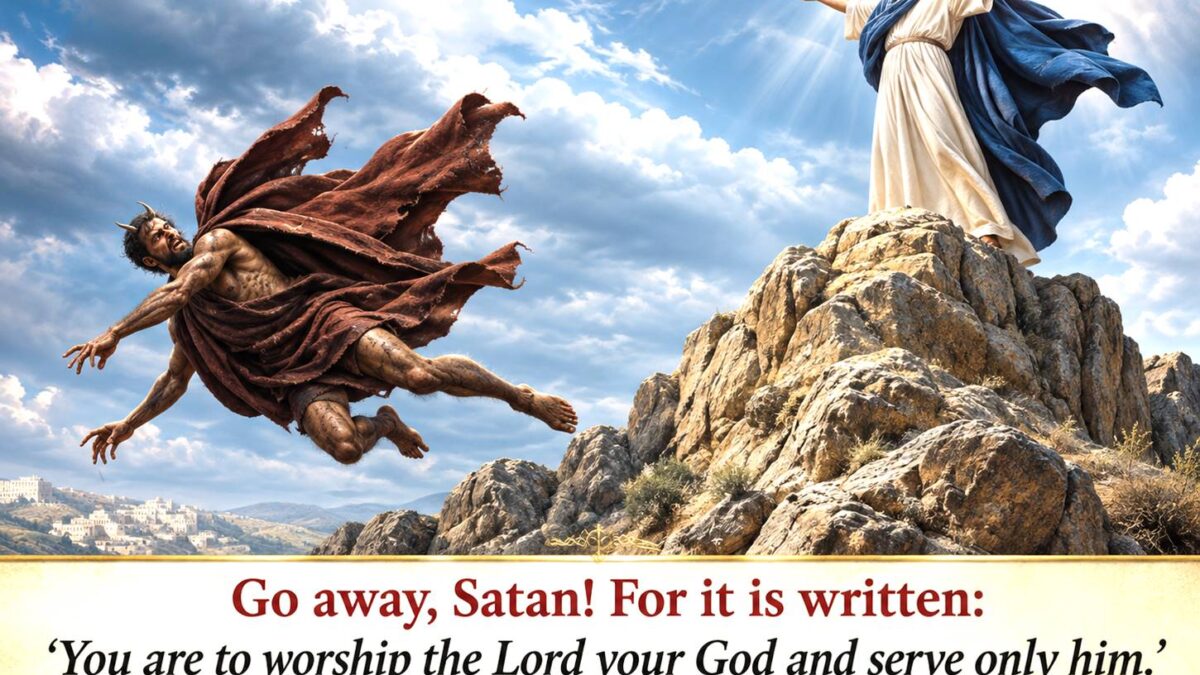
In Matthew 4:10 Jesus says:
“Go away, Satan! For it is written: ‘You are to worship the Lord your God and serve only him.’”
The NET Study Bible notes that this is “a quotation from Deut 6:13. The word ‘only’ is an interpretive expansion not found in either the Hebrew or Greek (LXX) text of the OT.”
This unique addition is not accidental. Jesus makes explicit what was already inherent in the command: a wholly unitary monotheistic claim concerning the one God alone who is deserving of religious or sacred service. Not surprisingly, the rest of the New Testament follows the same pattern.
The Greek verb latreuō occurs 21 times in the New Testament and characteristically describes religious or sacred service. It’s repeatedly used for God (e.g., Luke 1:74; 2:37; Acts 7:7; 24:14; Romans 1:9; Hebrews 9:14; 12:28; Revelation 7:15) and only two texts (Acts 7:42; Romans 1:25) apply the word for the false, idolatrous service of idols. This actually reinforces Scripture’s prohibition against transferring such sacred service away from the one God. Paul in Romans 1:25 condemns precisely this transfer of religious service from the one Creator to the creature.
Similarly, in the Old Testament Samuel commands Israel to remove its foreign gods and “serve Him only” (1 Sam. 7:3). The Hebrew literally reads “Him alone.” The Septuagint likewise reads “serve Him alone,” although it uses the more general Greek verb douleuō rather than latreuō. This provides a striking parallel to Matthew 4:10. Jesus takes the religious-service language of Deuteronomy 6:13 and expresses the strict unitary monotheism taught in scripture. For example, in the very next verse Israel removes the idols and “served Yahweh alone” (1 Sam. 7:4).
Most importantly, no New Testament writer makes the Son or the Holy Spirit the personal object of religious “service.” This fact is acknowledged by many Trinitarian scholars, including Arthur Wainwright in The Trinity in the New Testament:
“There is no instance of latreuein…which has Christ as object.”
This exclusive understanding is entirely consistent with Jesus’ own monotheism.
In Mark 12:29 he identifies the Shema of Deuteronomy 6:4 as the foremost commandment:
“Hear, Israel! The Lord our God is one Lord.”
The scribe then agrees with Jesus as to the meaning:
“You are right teacher. He is one and there is no other but Him.”
Jesus does not correct this unitary interpretation of the Shema. Instead, he blesses the man for answering “intelligently” and tells him, “You are not far from the Kingdom of God.”
Jesus makes the identity of this one God even more explicit in John 17:3 when he addresses his Father in prayer as: “the only true God.” And immediately distinguishes himself from the Father, the only one who is “true God,” by saying he is the Messiah whom that God commissioned.
The apostles maintain exactly the same distinction.
In 1 Corinthians 8:6 Paul states plainly that for Christians “there is one God, the Father,” and then distinguishes the Son as the “one lord Messiah.” The one God is the Father; Jesus is His anointed Messiah.
Lastly, Revelation 22:3 is commonly raised as a possible exception because “the throne of God and of the Lamb” precedes the singular expressions “His servants” and “serve Him.” Some therefore argue that religious “service” here includes the Lamb. But the grammar does not require that conclusion.
The singular pronoun leaves the precise antecedent open, and the text never explicitly says that the servants give “service” to the Lamb. The immediate context also allows God to remain the main subject. The only other occurrence of this type of “service” in Revelation is completely unambiguous. Revelation 7:15 says that the redeemed stand before God’s throne and “serve Him” day and night. And only two verses after Revelation 22:3, it is explicitly “the Lord God” who gives the servants their light. The verse therefore cannot serve as a clear counterexample to the otherwise consistent New Testament usage. At most, the singular pronouns are ambiguous; the verse does not explicitly make the Lamb the object of religious “service.” This is why Wainwright could still state that there is “no instance” of religious “service” having the Messiah as its object.
More decisively for the identity of God in Revelation, the glorified Son repeatedly calls the Father “my God” in Revelation 3:12, distinguishing “the name of my God” from his own “new name.” The risen and exalted Messiah therefore continues to have someone whom he identifies as his God.
Jesus’ addition of “only” in Matthew 4:10 is therefore highly significant. He makes the exclusive religious service of the one God unmistakable: “Him alone you will serve.”
The Old Testament had already supplied this logic in Deuteronomy 6:14 and stated it explicitly in 1 Samuel 7:3–4. Jesus reinforces it by confessing that “the Lord our God is one Lord” and by identifying his Father as “the only true God” in John 17:3.
Thus, throughout the New Testament, no legitimate use of religious “service” is clearly used either for the Son or the Holy Spirit. Where the recipient of this sacred service is explicitly identified, it is God—the one God whom the Son and the apostles identify as the Father. Jesus’ deliberate “Him only” in Matthew 4:10 therefore makes that exclusive boundary explicit from the outset of his ministry.
The verse reflects Jesus’ own unitary monotheistic confession of faith: the one God is his God and Father, and He alone is the ultimate recipient of sacred religious service.

Signature: bYFi/mM86IWQivqm1ls2EZ/61Yaqs/a7LLwDnMUhpDBG85o/gXI0E8JqU7UB1DGPVKrQOiB8nZEu2F26pqCv2iU8QTf6/7SMai0i5YOi2Gs7eWX/E7kbnX/apAkckKSwBlxr/xEZ1wBXKaysPuo16hMhncSzn/LU7DQt9KfdOWh2aedfHH5LhpPOH/OkzIJhDzd2fQSCrXfjFytCKL/q96HpyadE178l+aIB1phaXbVy88hiwEarTLXT4zcP+AK120i2dKVHnzuntXR4UuewLmZ8eBwcqNQSdT/Jecd1elBegaBgrt44w0muBfG/1B9kww4piLd8jQkyQGtjrRimDIrDf2xUSFdwrcfAvcSVFht24/G5pRwaa2we3GwUWYWQ6TSc0M0Yc8a00j1M0yebRtDYytRos20m00LAuWHx1dSmJfwWqcZzg3CppFGWbYvmEamIaoh9StQoyPpw6xrPdnXjDXBy+MigoJltsAQT7ccO8UfADqX/Vrmn9TWEw+wsVMEoBsEYRouqQZPzQcpuj/XbgjRua80V2gYK/ZBbZ0MNBT73i5I0mgvHWonvnwoRl8JiV8PWamVDlEOUrGmAYVCZM6d79tnRnv+/UYph1DNhWhDHHMolq/DDzm6X2cuKDwd/tXUds6hMEZrJtijbBfNOTjv7cT8QiQLgzEFhUnlugMyC71oPziUoCUj7wEdx7AiApBj4jDXFTLzk7iSKOSjT0xJaS+lPbw/QR5CdUW7kzYDBfujmwLFa9EtAUQAyFPZ3RB9zu0CX6XoTTOyi0q3CyO6XdcM/D7B/xHM8t67fPvdJzIij6hmxcyLMTRT70v5Mb7jKTCvEOqf+LQTnlP3rJ8EHkyCusJ6ZVl7RIyXAu3Lgkb4slD+9ml8iFL3wckGzsjubsUtmx++RpMDPjR/XvMhuG+l0z9N+YMf8r5/ak5Ha7q2ymzghYwupw2f0