

Son of God: the Constraint of Monotheism
July 7, 2026
Why Are Most Christians Trinitarians?
August 8, 2026One LORD God and His Messiah, lord Jesus
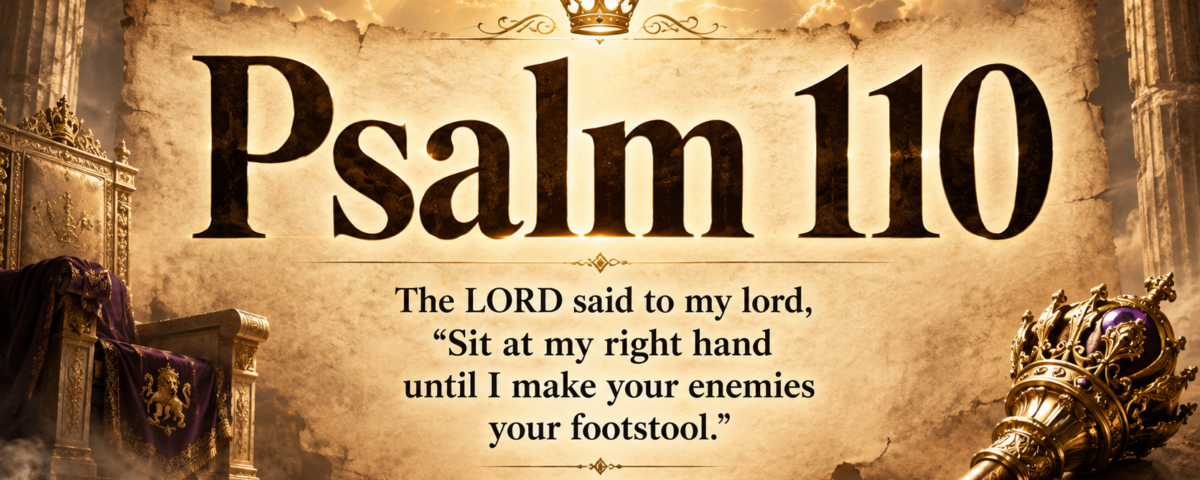
The word “Lord” must be carefully distinguished when used of God and of His Son, because the Bible presents us with two Lords: the LORD God, Yahweh, and His appointed lord, the Messiah Jesus. This distinction begins with Psalm 110:1, the Old Testament verse most often cited or alluded to by New Testament writers.
Here, Yahweh God commands David’s lord, the Messiah, to sit at His right hand. The Messiah is not Yahweh Himself, but the one exalted by Yahweh. This is exactly how Jesus and his Apostles understood Psalm 110:1.
Jesus used it to show that the Messiah is David’s superior lord, yet still distinct from Yahweh (Matt. 22:41-46).
Peter then applies it directly to Jesus at Pentecost, declaring: “God has made this Jesus both Lord and Christ” (Acts 2:36).
That statement is crucial showing that God made Jesus both lord and Messiah. Jesus’ lordship is given, appointed by God. Hence, the title “lord” is used of Jesus hundreds of times in the NT.
For example, Luke 2:26 says that it had been revealed to Simeon through the holy spirit that he would not die before he had seen “the Lord’s Messiah.” That is, Jesus is the Messiah of the Lord God, not the Lord God Himself. This also explains why Peter later commands believers in 1 Peter 3:15 to honor Christ as lord in their hearts. The Messiah is to be honored as God’s exalted lord, the one seated at God’s right hand.
This is also crucial background for Paul’s repeated use of Old Testament Yahweh texts in relation to Jesus. Around 20 times in his letters, Paul applies Yahweh-language to the exalted Messiah — not because Jesus is Yahweh, but because Jesus is Yahweh’s supreme agent, royal representative, and appointed lord. For example, Paul refers to believers as those who “call on the name of our lord Jesus Christ” (1 Cor. 1:2), echoing the well-known Old Testament phrase:
“And it will be that everyone who calls on the name of Yahweh Will be delivered” (Joel 2:32).
Paul does something similar in Romans 10:9-13. He tells believers to confess Jesus as lord, while still maintaining that God raised him from the dead. The distinction remains clear: God raises and appoints; Jesus is raised and appointed.
The same pattern appears in Philippians 2:9-11. God highly exalts Jesus and gives him the name above every name, so that every knee will bow and every tongue confess that Jesus Messiah is lord — “to the glory of God the Father.” The exaltation of Jesus does not replace the one God; it glorifies Him.
For Paul, therefore, “the great day of Yahweh” (Zeph. 1:14) is now also described in Messianic terms as “the day of Christ” (Phil. 1:6, 10; 2:16), or “the day of our lord Jesus Christ” (1 Cor. 1:8; cp. 2 Cor. 1:14). This is because Yahweh will judge and rule the world through the man He has appointed, the lord Messiah Jesus (Acts 17:31).
Paul summarizes the whole matter beautifully:
“For us there is one God, the Father… and one lord, Jesus Messiah” (1 Cor. 8:6).
So the Bible’s language of “Lord” must not be flattened into Trinitarian confusion. There is one LORD God, Yahweh, the Father, and there is one lord Messiah, Jesus, whom Yahweh has raised, exalted, and appointed to rule at His right hand until the Kingdom is fully established on a restored earth.



Signature: YLnQvfddA2MpNbRD5eQ6rDm65YEl/n6q8Gt96f/bJ8VtPGewgxlxjb6Zg1AmwmNGs2XFSBBKedheDop43SyiV0Ev/kXIuXJ0qdxgfRkRqJqE8dzr1o0sIqvqjtTKi3/CO5lJLXye1eD0uH4Uaz75R4e5omhEpD716ZGGmxqUEsTiIYp5frNuVPIs13wwezvQDf1dL6s3vFE9tOD2EwFMWlH2PfwpVNJ2WDPTJiCWoPs92OZ8ndCk1YbQs+a5xYQm/Cb1IRJB/9xxKcMvbrikqns7yK9ki7DmUxwOrMxDA1TzQqu6eKCq9dMAzCyyaimKXN6vDPA2QTSQSHcs2/XzD24gheKgmbbq5/lCmUf1RWBL1xtL71kYB+JXPlroLzvx4aysGOg1rd4/I4liBNjVIfhrmMKX1TeSK3nDJGqHw4cS+l7vSGzRkA9Qf+Mx8Ql1XwonDFYpaYz5M5ZdYy/j7Hb9iLQuqNLycln1UUQV27QLgkrsKnPnhgFO9X18Zbohbq4T5mt7IEgE9nfe5HEEX7ABx9QW5+c37Gb+tg+/1CZ4cx51nbLiZduq9q7NqKUtX9ypyg2Ci2FZvx8qQULni99LwpB2vcnzta8Dg3AyRYFm986mQbZRmw8YESg+f+12dMb7Nj5BaUe9YmPRTbmatiX7IbjXJzaz1HdMblGtxJwt9/eg8IC7riANPVpzdrKssQH67X/dvrzfPPKO8ZAjzBB0d6sTKZu7UnauBWWqfHEmfRWjeeWcIbZqtY0Kf9G64uWjPGaMGu5wF09EWZ9T5WiZKtwykW9Jld/H/lH2XJqoeDrGpe9tNIIS3dXWB9Xq/8a26h1fzWaRgCIiCaw6kArCvSuhZVfJHdMRgT1zacKyIOb37NYcsGzlFDKjsaW0D51opdJPmssaIywaDn/tmnuIJITlav8EVr5rL5zsoxeFlJX4wN0DRcc8Ghsq8gct