

Divine Sacred Worship Explained
January 5, 2026
When “Three’s Not a Crowd”
January 20, 2026Psalm 110:1 Golden Thread
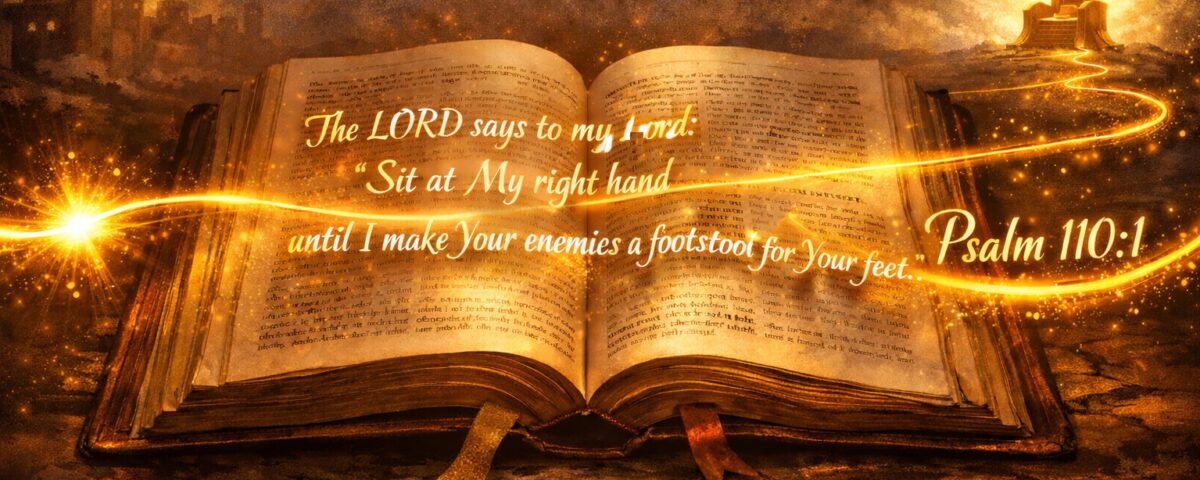
Psalm 110:1 is the most frequently quoted psalm in the New Testament. As a result, it has long stood at the center of debates about the identity of the second lord, whom David calls “my lord,” and about what the text actually reads. As Bible students, however, we must begin with sound hermeneutical principles: we cannot claim a verse “should” say something different unless there is compelling evidence—the kind of evidence we see in the well-documented textual issues of 1 John 5:7–8 (the Johannine Comma). In the case of Psalm 110:1 there is not even a hint of corruption—no manuscript evidence, no ancient complaint, nothing. The text has come down to us exactly as the inspired writer penned it:
“Yahweh said to my lord (adoni): Sit at My Right Hand until I make your enemies your footstool.”
The Hebrew adoni (“my lord”) appears 195 times in the Hebrew Bible and is never once used for Yahweh. It is always a human (or occasionally angelic) superior. The Septuagint faithfully renders it τῷ κυρίῳ μου (“to my lord”), and every New Testament quotation (Matt 22:44; Mark 12:36; Luke 20:42; Acts 2:34) preserves the distinction by using the dative τῷ κυρίῳ μου—never confusing it with the usual ὁ κύριος (“the Lord”) or simply “LORD” for Yahweh.
Modern Hebrew New Testaments produced by Christian organizations consistently render the second lord in Psalm 110:1 as לַאֲדוֹנִי (l’adoni) with a lowercase “a,” while Yahweh is always אֲדוֹנָי (Adonai). The same distinction appears when Thomas addresses Jesus in John 20:28.
Even in Aramaic (Jesus’ spoken language), the honorific address mari or mar was commonly used for respected human teachers. As scholar Paula Fredriksen notes:
“Doubtless some of Jesus’ Aramaic-speaking followers would have used mari when courteously addressing him.”
Yet for more than a century, however, many notable dictionaries, encyclopedias, scholars, and standard study Bibles have continued to spread the Trinitarian claim that the second lord is in fact also Yahweh—that is, Adonai rather than adoni. Examples abound:
Names and Titles of the Lord Jesus Christ, Charles Spear, 1841, p 238:
“It is said to this day the Jewish doctors always read adon or adoni, Lord, or my Lord, where they find Jehovah.”
The Companion Bible of E.W. Bullinger, my Lord = Adonai, Ap. 4.8: i.e. David’s Lord: i.e. the Messiah. Cp. Matt. 22.41-46.
Unity and Diversity in the New Testament, Dunn, 1990, p. 393, note 43:
“The Hebrew of Ps. 110.1 uses two different words – Yahweh and Adonai.
Encyclopedia Americana, 1949, 6:624:
“In Psalm 110:1 “Yahweh said to Adonai…”
Ryrie Study Bible, NASB, Expanded Edition 1995 Update:
“David hears a conversation between the LORD (Yahweh, God the Father) and David’s Lord (Adonai, the Messiah).”
But if the second lord were in fact another Yahweh, it would mean that one co-equal Yahweh is greater than the other and can issue commands to Him—an idea that is logically incoherent and, from a purely scriptural standpoint, blasphemously polytheistic. The Bible does not teach binitarianism (two Gods). And God cannot be told to sit at someone else’s right hand, because no one is greater than He.
The entire Psalm 110 has long been recognized as messianic by both Jewish and Christian interpreters. The Wycliffe Bible Commentary notes:
“The quotation is taken from Ps 110:1, a passage which the Jews had long recognized as Messianic.”
Furthermore, the earliest Jewish interpretations never understood the second “lord” to be God Himself. A striking midrash preserved in the name of Rabbi Yodan (quoting Rabbi Chama) states:
“In the age to come the Holy One—blessed be He!—will make King Messiah sit at His right hand (as it is said, ‘The LORD said unto my lord, Sit thou at my right hand’), and Abraham at His left… But Abraham’s face grows pale, and he says, ‘The son of my son sits on the right, but I on the left.’ The Holy One appeases him: ‘Thy son’s son is at My right, and I Myself am at thy right.’”
Here the future Messiah—not God—is seated at God’s right hand, while God Himself moves to support the His anointed one. The second “lord” is clearly distinguished from the first “LORD,” i.e., Yahweh. But then v 5 suddenly shifts the imagery:
“Adonai [now spelled with a different pointing than adoni] is at your right hand; he will shatter kings on the day of his wrath.”
Whereas verse 1 is a royal enthronement scene (David’s human “my lord” is commanded to sit at Yahweh’s right hand), verse 5 is a battle scene: the divine Adonai now stands at the human king’s right hand to fight on his behalf—exactly as God stands “at the right hand of the needy” (Ps 109:31) to save and protect him. Trinitarian scholars themselves acknowledge this shift and rightly explain it. Ellicott’s Commentary, for example, states:
“The change of position of Jehovah from the king’s right hand [v. 1] to his left [v. 5] is simply due to the usage of the language. To sit at the right hand was an emblem of honour; to stand at the right hand was a figure of protecting might… and the imagery of a battle caused the change of expression.”
Throughout the Old Testament, God repeatedly defeats enemies through a human agent (Num 24:8, 17; Judg 5:26; 2 Sam 22:39; Ps 18:39). Psalm 110 is no exception.”
Throughout the Old Testament, God repeatedly defeats enemies through a human agent (Num 24:8, 17; Judg 5:26; 2 Sam 22:39; Ps 18:39). Psalm 110 is no exception. As Dr. J. R. Daniel Kirk writes in A Man Attested by God:
“Psalm 110 [is] a picture of an idealized priestly king… God’s own activity on the earth is executed through the wars the human king leads.”
Similarly at Qumran, the figure of Melchizedek in 11Q13 is an exalted heavenly priest who judges and conquers—a role normally reserved for God—yet the scroll still treats him as a distinct, exalted human representative occupying God’s place in the end times.
When Jesus quotes Psalm 110:1, he does not argue that David called the Messiah “Adonai.” Instead, he asks how David can call his own son “my lord” if the son is supposed to be inferior to the father. In ancient Near Eastern culture, fathers always held higher honor than sons—unless God Himself supernaturally elevates the son (as happened with Joseph in Genesis 37, where Jacob initially rebuked the dream but later accepted God’s sovereign plan). The Bible Knowledge Commentary notes on Matthew 22:44:
“In the Jewish culture of that time such a thing was inconceivable… That this did happen in Joseph’s case was due to God’s supernatural intervention.”
Jesus’ point is not that the Messiah is Yahweh, but that the Messiah—David’s human descendant—will be exalted by God to a position above his own ancestor David.
To summarize the undeniable textual facts:
- There is zero manuscript evidence that Psalm 110:1 ever read differently.
- The earliest Jewish interpretations applied the second “lord” to Abraham, Hezekiah, or the future human Messiah—never to Yahweh.
- The Hebrew form adoni (“my lord”) is never used for Yahweh anywhere in the OT.
- The Greek Septuagint and all New Testament citations preserve the distinction.
- Virtually every modern English translation (NIV, NRSV, NET, NAB, etc.) reflects the difference by printing “LORD” (YHWH) in all caps.
Psalm 110:1 says exactly what God intended: The one LORD (Yahweh) speaks to someone David calls “my lord” (adoni not Adonai)—the promised Messiah—and invites him to sit at His right hand as the exalted human king and priest through whom God will subdue the nations. Far from teaching a plurality in the Godhead, the verse beautifully foreshadows the supernatural exaltation of the human Son of David to the highest place of honor alongside Yahweh Himself.

Signature: YLnQvfddA2MpNbRD5eQ6rDm65YEl/n6q8Gt96f/bJ8VtPGewgxlxjb6Zg1AmwmNGs2XFSBBKedheDop43SyiV0Ev/kXIuXJ0qdxgfRkRqJqE8dzr1o0sIqvqjtTKi3/CO5lJLXye1eD0uH4Uaz75R4e5omhEpD716ZGGmxqUEsTiIYp5frNuVPIs13wwezvQDf1dL6s3vFE9tOD2EwFMWlH2PfwpVNJ2WDPTJiCWoPs92OZ8ndCk1YbQs+a5xYQm/Cb1IRJB/9xxKcMvbrikqns7yK9ki7DmUxwOrMxDA1TzQqu6eKCq9dMAzCyyaimKXN6vDPA2QTSQSHcs2/XzD24gheKgmbbq5/lCmUf1RWBL1xtL71kYB+JXPlroLzvx4aysGOg1rd4/I4liBNjVIfhrmMKX1TeSK3nDJGqHw4cS+l7vSGzRkA9Qf+Mx8Ql1XwonDFYpaYz5M5ZdYy/j7Hb9iLQuqNLycln1UUQV27QLgkrsKnPnhgFO9X18Zbohbq4T5mt7IEgE9nfe5HEEX7ABx9QW5+c37Gb+tg+/1CZ4cx51nbLiZduq9q7NqKUtX9ypyg2Ci2FZvx8qQULni99LwpB2vcnzta8Dg3AyRYFm986mQbZRmw8YESg+f+12dMb7Nj5BaUe9YmPRTbmatiX7IbjXJzaz1HdMblGtxJwt9/eg8IC7riANPVpzdrKssQH67X/dvrzfPPKO8ZAjzBB0d6sTKZu7UnauBWWqfHEmfRWjeeWcIbZqtY0Kf9G64uWjPGaMGu5wF09EWZ9T5WiZKtwykW9Jld/H/lH2XJqoeDrGpe9tNIIS3dXWB9Xq/8a26h1fzWaRgCIiCaw6kArCvSuhZVfJHdMRgT1zacKyIOb37NYcsGzlFDKjsaW0D51opdJPmssaIywaDn/tmnuIJITlav8EVr5rL5zsoxeFlJX4wN0DRcc8Ghsq8gct