

Did Jesus Claim to be God?
April 15, 2026
He is Risen?
April 15, 2026A Doctrine Built on Difficult Texts
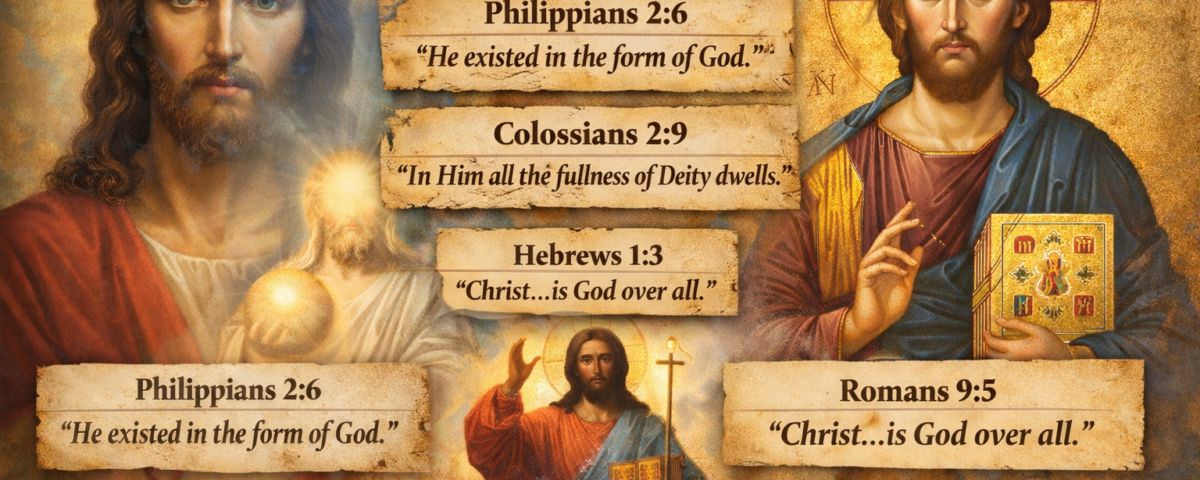
Few claims in Christianity are repeated more confidently, and for longer, than the assertion that the New Testament clearly teaches that Jesus is God. Yet the evidence is far less solid than many assume. In fact, one of the most respected Trinitarian scholars, Murray J. Harris, concedes in Jesus as God that the application of the title theos (“God”) to Jesus is “exceedingly rare,” amounting to only “7 certain, very probable, or probable instances out of a total of 1,315 NT uses of theos.” That should immediately call into question any claim that Jesus is clearly presented as God in the New Testament. If this were the central and unmistakable teaching of the Christian Scriptures, we would expect the evidence to be frequent, straightforward, and beyond dispute. But it is not.
Harris makes an even more revealing admission: “It’s a curious fact that each of the [disputed God texts] contains an interpretative problem of some description. Actually, most contain two or three.”
That means the very passages most often used to prove that Jesus is God turn out to be the very passages burdened with punctuation problems, textual uncertainty, grammatical ambiguity, or contextual difficulty. Among them are the millennia-old so-called Trinitarian “proof texts”: John 1:1c and Romans 9:5, where punctuation affects meaning; John 1:18, John 20:28, 2 Peter 1:1, 2 Thessalonians 1:12, Titus 2:13, and 1 John 5:20, where textual or grammatical questions remain; and Hebrews 1:8-9, where the context is heavily debated.
In other words, the case is not built on clear and repeated statements, but on a small cluster of difficult texts whose interpretation is contested even by noted Trinitarian scholars.
More importantly, Harris acknowledges the wider New Testament pattern: “In all strands of the NT, theos generally signifies the Father. [Hence,] the identity between ho theos and ho pater as proper names referring to persons must be numerical: ‘God’ is to be equated with ‘the Father.’”
In other words, across the New Testament, the word “God” ordinarily refers to the Father. Jesus, by contrast, is consistently distinguished from God as His uniquely begotten human Son and anointed Lord, the Messiah. This is the controlling pattern of New Testament apostolic belief.
There is yet another difficulty, one often overlooked in popular discussions: textual corruption in the transmission of the New Testament.
Some early scribes appear to have altered passages in ways that made them more useful to later Trinitarian theology. This problem was already recognized by Erasmus in the 16th century, most famously in connection with the so-called Johannine Comma in 1 John 5:7-8, and by Sir Isaac Newton in the 18th century.
In modern times, Bart D. Ehrman’s The Orthodox Corruption of Scripture remains one of the most important studies on this subject. Ehrman documents readings in which copyists seem to have pushed the text in a more overtly “Jesus is God” direction. For example, in John 19:40, “the body of Jesus” became “the body of God”; in Mark 3:11, “You are the Son of God” became “You are God, the Son of God”; in Luke 7:9, “when Jesus heard this” became “when God heard this”; in Acts 20:28, the wording was shaped to suggest that God purchased the church with His own blood; in Jude 5, some readings introduce “Jesus” or “the God Christ”; and in Galatians 2:20, “Son of God” was altered in some witnesses toward “God the Son.”
Taken together, the pattern is difficult to ignore. The New Testament rarely calls Jesus “God.” The few passages pressed into service for that claim are among the most disputed in the discussion. The ordinary New Testament use of theos points to the Father. And in some instances, later scribes seem to have adjusted the wording of the text to better support an emerging Trinitarian reading. That is not what we would expect if the so-called “deity of Christ,” or his “double nature” as God-man, were the plain teaching of Scripture from the beginning.
Instead, the New Testament evidence presents a far simpler and more coherent picture: the one God of the Bible is the Father, and Jesus is His uniquely begotten human Son and exalted Lord Messiah, not another LORD God. To make Jesus into Yahweh Himself would be, according to the creed of Jesus, his apostles, and the early church in Acts, one Yahweh too many. The burden, then, does not lie with those who reject the God-man or “Jesus-is-God” theory. It lies with those who would build a massive doctrine on a handful of difficult texts and then call that doctrine a divine mystery, even though the New Testament never states it clearly or consistently.

Signature: YLnQvfddA2MpNbRD5eQ6rDm65YEl/n6q8Gt96f/bJ8VtPGewgxlxjb6Zg1AmwmNGs2XFSBBKedheDop43SyiV0Ev/kXIuXJ0qdxgfRkRqJqE8dzr1o0sIqvqjtTKi3/CO5lJLXye1eD0uH4Uaz75R4e5omhEpD716ZGGmxqUEsTiIYp5frNuVPIs13wwezvQDf1dL6s3vFE9tOD2EwFMWlH2PfwpVNJ2WDPTJiCWoPs92OZ8ndCk1YbQs+a5xYQm/Cb1IRJB/9xxKcMvbrikqns7yK9ki7DmUxwOrMxDA1TzQqu6eKCq9dMAzCyyaimKXN6vDPA2QTSQSHcs2/XzD24gheKgmbbq5/lCmUf1RWBL1xtL71kYB+JXPlroLzvx4aysGOg1rd4/I4liBNjVIfhrmMKX1TeSK3nDJGqHw4cS+l7vSGzRkA9Qf+Mx8Ql1XwonDFYpaYz5M5ZdYy/j7Hb9iLQuqNLycln1UUQV27QLgkrsKnPnhgFO9X18Zbohbq4T5mt7IEgE9nfe5HEEX7ABx9QW5+c37Gb+tg+/1CZ4cx51nbLiZduq9q7NqKUtX9ypyg2Ci2FZvx8qQULni99LwpB2vcnzta8Dg3AyRYFm986mQbZRmw8YESg+f+12dMb7Nj5BaUe9YmPRTbmatiX7IbjXJzaz1HdMblGtxJwt9/eg8IC7riANPVpzdrKssQH67X/dvrzfPPKO8ZAjzBB0d6sTKZu7UnauBWWqfHEmfRWjeeWcIbZqtY0Kf9G64uWjPGaMGu5wF09EWZ9T5WiZKtwykW9Jld/H/lH2XJqoeDrGpe9tNIIS3dXWB9Xq/8a26h1fzWaRgCIiCaw6kArCvSuhZVfJHdMRgT1zacKyIOb37NYcsGzlFDKjsaW0D51opdJPmssaIywaDn/tmnuIJITlav8EVr5rL5zsoxeFlJX4wN0DRcc8Ghsq8gct