
How Many is Yahweh? Isaiah 48:16
August 8, 2026
The Messiah Son of David by Mary
September 8, 2026Trinity: We Have a Logical Problem
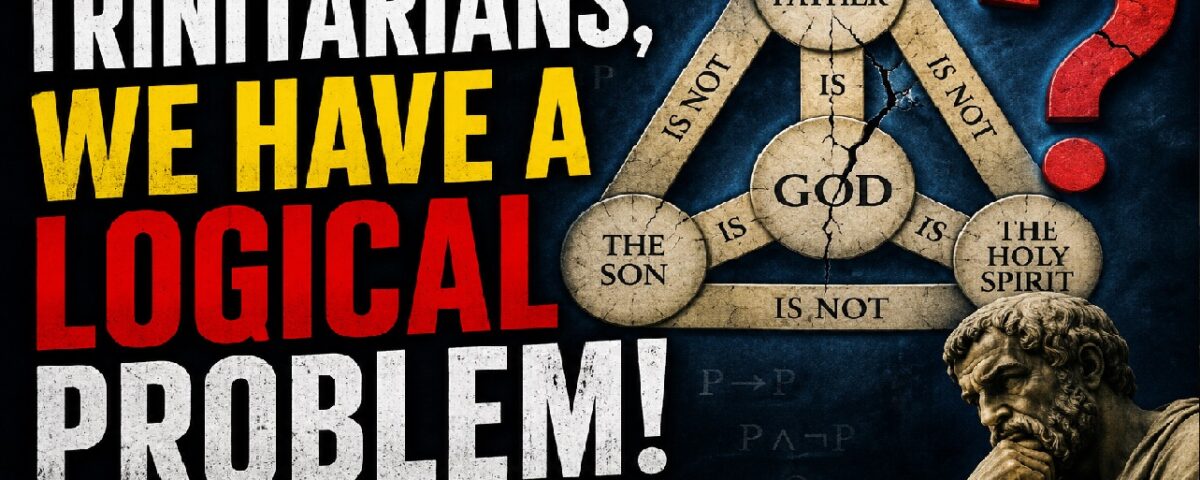
There is no biblical evidence showing that the one God of Israel, who is identified by the personal Hebrew divine name Yahweh, eternally exists as three distinct, co-equal Persons—the Father, the Son, and the Holy Spirit—while somehow remaining not three gods, but only one God.
On the contrary, the Trinity contradicts the inspired revelation and words of Scripture, beginning with what Jesus himself called “the first and greatest of all commandments,” the Shema:
“Hear, O Israel! Yahweh our God, is one Yahweh!” (Deuteronomy 6:4; Mark 12:29).
The theory rather than “doctrine” of the Trinity violates basic logic and mathematics. These are integral systems created by the one God Himself. Without order, we would return to an earth filled with nothing but “darkness”—in other words, disorder and chaos (Genesis 1:1–2). In fact, the so-called LPT—the logical problem of the Trinity—has been openly acknowledged and discussed by notable Trinitarians for decades.
Therefore, the Trinity is not, properly speaking, biblical monotheism, which is revealed as unitary monotheism. The one God is described tens of thousands of times by singular personal pronouns, singular verbs, and other singular grammatical forms.
When Trinitarians appeal to post-biblical, Gentile-influenced philosophical terms such as ousia or perichoresis, they effectively abandon the language of Scripture. Neither the Hebrew patriarchs, such as Abraham, nor the later prophets, such as Moses and Isaiah—and certainly neither Jesus nor his apostles—ever taught that the one God is a Trinity of Persons, either implicitly or explicitly.
As Christians, let us remain faithful to the Son of God himself, who consistently identifies the one God, or “the only true God,” as someone distinct from himself:
“You believe in God; believe also in me” (John 14:1b).
“The Father is greater than I” (John 14:28).
“The Father is the only true God, and Jesus Messiah is the one He sent” (John 17:3).
“I am ascending to my Father and your Father, and to my God and your God” (John 20:17).
Jesus says, “I and the Father are one,” but in his prayer to the Father he also asks that believers may be “one” in the same way (John 17:21–23). No one imagines that Christians become part of one so-called “being” or “substance.” The oneness is a unity of purpose, mission, and agreement—not a shared personal identity.
In Revelation 1:6, Jesus “made us a kingdom, priests to his God and Father.”
Later, in Revelation 3, Jesus calls the Father “my God” multiple times. As someone once said, “Show me someone who has a God, and I will show you someone who is not God.”
Appeals to Paul or any other writer are no more supportive of the idea that the one God is a Trinity of Persons.
Galatians 3:20 says:
“Now a go-between (intermediary) has to do with and implies more than one party [there can be no mediator with just one person]. Yet God is [only] one Person” (Amplified Bible, Classic Edition).
Paul distinguishes between the one God and the man Messiah in 1 Timothy 2:5, who is himself human.
Jesus is also called the servant of God (Acts 3:13) and the Lamb of God (John 1:29).
None of this means that God is a lamb, that God is man (i.e., impersonal human nature) but not a man (an actual human person, as Chalcedon defines the so-called Hypostatic Union, Double nature of “God-man” at the same time). Nor is God His own servant or messenger.
Note how most of the verses so far cited come from the Gospel of John—the favorite Gospel of many Trinitarians, no less.
Yet John along with the rest of the NT do not support the one God as Trinity of Persons.
James 2:19 says:
“You believe that God is one; that is right! Even the demons believe that and tremble.”
1 Peter 1:3 says:
“Blessed be the God and Father of our Lord Jesus Messiah.”
Likewise, the New Testament doxologies ascribe glory to “the only God,” who is always the Father, through or alongside Jesus Messiah (Romans 16:27; 1 Timothy 1:17; Jude 25).
When confronted with this kind of scriptural evidence, Trinitarians often play what I call “the mystery card.” Scripture, however, never excuses contradiction as faith, doctrine as unsound for “God is not a God of confusion” (1 Corinthians 14:33).
To reject the Trinity then is not an attack upon, or a diminishment of, God or His unique human Son. Rather, it is a mark of adherence to the sound teaching of our lord Messiah, Jesus. Testing any self-professed “doctrine” against Scripture is never heresy; it is mandated by Scripture itself (Deuteronomy 13; John 7:24; Acts 17:11; 1 John 4; 1 Thessalonians 5:21).
Christians will not be judged according to their adherence to post-biblical creeds. Faith requires understanding, not the uncritical acceptance of invented, bizarre, and illogical mysteries that can never be made coherent.
The one God, the Father, will judge according to a clear and specific standard of truth. This truth is required for “the obedience of faith” and begins with the Shema affirmed by Jesus himself (Mark 12:29). This is the yoke that will lead us to the promised land, the Christian’s reward which is entrance into God’s coming Kingdom on a restored earth. As Jesus told the friendly scribe in Mark 12:34:
“You are not far from the Kingdom of God.”

Signature: YLnQvfddA2MpNbRD5eQ6rDm65YEl/n6q8Gt96f/bJ8VtPGewgxlxjb6Zg1AmwmNGs2XFSBBKedheDop43SyiV0Ev/kXIuXJ0qdxgfRkRqJqE8dzr1o0sIqvqjtTKi3/CO5lJLXye1eD0uH4Uaz75R4e5omhEpD716ZGGmxqUEsTiIYp5frNuVPIs13wwezvQDf1dL6s3vFE9tOD2EwFMWlH2PfwpVNJ2WDPTJiCWoPs92OZ8ndCk1YbQs+a5xYQm/Cb1IRJB/9xxKcMvbrikqns7yK9ki7DmUxwOrMxDA1TzQqu6eKCq9dMAzCyyaimKXN6vDPA2QTSQSHcs2/XzD24gheKgmbbq5/lCmUf1RWBL1xtL71kYB+JXPlroLzvx4aysGOg1rd4/I4liBNjVIfhrmMKX1TeSK3nDJGqHw4cS+l7vSGzRkA9Qf+Mx8Ql1XwonDFYpaYz5M5ZdYy/j7Hb9iLQuqNLycln1UUQV27QLgkrsKnPnhgFO9X18Zbohbq4T5mt7IEgE9nfe5HEEX7ABx9QW5+c37Gb+tg+/1CZ4cx51nbLiZduq9q7NqKUtX9ypyg2Ci2FZvx8qQULni99LwpB2vcnzta8Dg3AyRYFm986mQbZRmw8YESg+f+12dMb7Nj5BaUe9YmPRTbmatiX7IbjXJzaz1HdMblGtxJwt9/eg8IC7riANPVpzdrKssQH67X/dvrzfPPKO8ZAjzBB0d6sTKZu7UnauBWWqfHEmfRWjeeWcIbZqtY0Kf9G64uWjPGaMGu5wF09EWZ9T5WiZKtwykW9Jld/H/lH2XJqoeDrGpe9tNIIS3dXWB9Xq/8a26h1fzWaRgCIiCaw6kArCvSuhZVfJHdMRgT1zacKyIOb37NYcsGzlFDKjsaW0D51opdJPmssaIywaDn/tmnuIJITlav8EVr5rL5zsoxeFlJX4wN0DRcc8Ghsq8gct