

David calls his son “my lord”
October 7, 2026
What did the son know & when did he know it?
October 7, 2026Yahweh at your right hand
Signature: YLnQvfddA2MpNbRD5eQ6rDm65YEl/n6q8Gt96f/bJ8VtPGewgxlxjb6Zg1AmwmNGs2XFSBBKedheDop43SyiV0Ev/kXIuXJ0qdxgfRkRqJqE8dzr1o0sIqvqjtTKi3/CO5lJLXye1eD0uH4Uaz75R4e5omhEpD716ZGGmxqUEsTiIYp5frNuVPIs13wwezvQDf1dL6s3vFE9tOD2EwFMWlH2PfwpVNJ2WDPTJiCWoPs92OZ8ndCk1YbQs+a5xYQm/Cb1IRJB/9xxKcMvbrikqns7yK9ki7DmUxwOrMxDA1TzQqu6eKCq9dMAzCyyaimKXN6vDPA2QTSQSHcs2/XzD24gheKgmbbq5/lCmUf1RWBL1xtL71kYB+JXPlroLzvx4aysGOg1rd4/I4liBNjVIfhrmMKX1TeSK3nDJGqHw4cS+l7vSGzRkA9Qf+Mx8Ql1XwonDFYpaYz5M5ZdYy/j7Hb9iLQuqNLycln1UUQV27QLgkrsKnPnhgFO9X18Zbohbq4T5mt7IEgE9nfe5HEEX7ABx9QW5+c37Gb+tg+/1CZ4cx51nbLiZduq9q7NqKUtX9ypyg2Ci2FZvx8qQULni99LwpB2vcnzta8Dg3AyRYFm986mQbZRmw8YESg+f+12dMb7Nj5BaUe9YmPRTbmatiX7IbjXJzaz1HdMblGtxJwt9/eg8IC7riANPVpzdrKssQH67X/dvrzfPPKO8ZAjzBB0d6sTKZu7UnauBWWqfHEmfRWjeeWcIbZqtY0Kf9G64uWjPGaMGu5wF09EWZ9T5WiZKtwykW9Jld/H/lH2XJqoeDrGpe9tNIIS3dXWB9Xq/8a26h1fzWaRgCIiCaw6kArCvSuhZVfJHdMRgT1zacKyIOb37NYcsGzlFDKjsaW0D51opdJPmssaIywaDn/tmnuIJITlav8EVr5rL5zsoxeFlJX4wN0DRcc8Ghsq8gct
Psalm 110:5 is sometimes misused as a so-called “proof text” to claim that the Messiah is Adonai—that is, Yahweh—on the assumption that “the Lord” in this verse is the same figure who sits at Yahweh’s right hand in verse 1. However, this reading either misunderstands or ignores the important shift in setting, imagery, and Hebrew terminology within the psalm itself.
Verse 1 presents a vision of David’s lord, who is commanded to sit at the right hand of Yahweh, the one God of Israel. The distinction between the two figures is made explicit both by the imagery and by the words used to describe each “Lord.”
The first Lord is identified by the well-known personal Hebrew divine name used exclusively for the one God of Israel: Yahweh, or Jehovah. The second is called “my lord” by David—adoni—a Hebrew word that, in all 195 of its appearances in the Hebrew Scriptures, is never used for Deity.
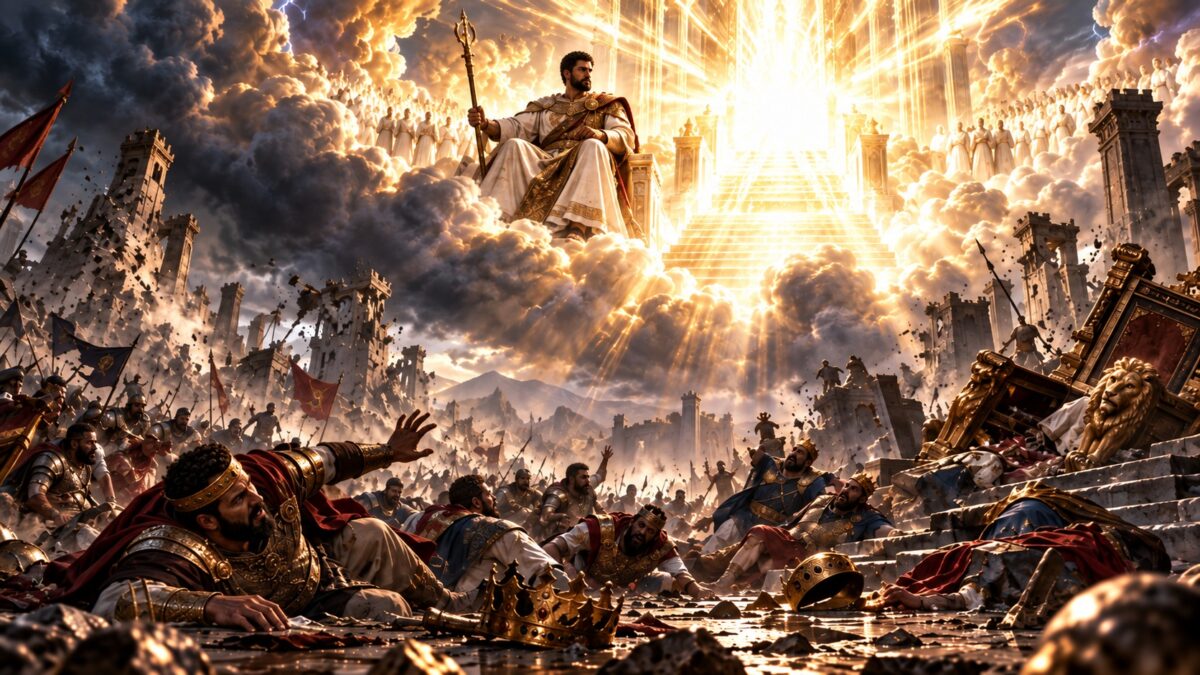
Verse 5, by contrast, shifts to a battle scene. Here, Adonai—another Hebrew designation used exclusively for Yahweh, the God mentioned in verse 1—is described as being “at the right hand” of His appointed human king, David’s “my lord” (adoni, not Adonai).
The imagery of Adonai-Yahweh standing at someone’s right hand is, in this context, one of protection, support, and military aid.
In fact, the same imagery appears at the end of the preceding psalm. Psalm 109:31 says:
“For He [that is, Yahweh-Adonai] stands at the right hand of the needy one, To save him from those who judge his soul.”
No one would claim that the needy person at whose right hand Yahweh stands is therefore also Yahweh, Adonai.
Thus, Psalm 110:5 does not mean that David’s human lord and master from verse 1 is suddenly and shockingly introduced as another Yahweh, Adonai. Instead, the verse portrays Adonai as standing beside and empowering His chosen human representative—David’s adoni—in battle. This interpretation is acknowledged by many Trinitarian commentators.
Ellicott’s Commentary observes:
“The change of position of Jehovah from the king’s right hand [Ps. 110:1] to his left [Ps. 110:5] is simply due to the usage of the language. To sit at the right hand was an emblem of honour; to stand at the right hand was a figure of protecting might (Psalm 16:8; 109:31); and the imagery of a battle into which the song now plunges caused the change of expression.”
Throughout the Old Testament, Yahweh works through chosen human agents to defeat their enemies. This pattern appears in Numbers 24:8, 17; Judges 5:26; 2 Samuel 22:39; and Psalm 18:39. Yahweh remains the ultimate source of victory, while His appointed human ruler acts as His visible representative on earth.
Furthermore, a similar pattern of delegated divine agency appears in one of the Qumran scrolls, where Melchizedek is portrayed as a savior, judge, and conqueror at the end of this present evil age. He carries out functions and roles belonging uniquely to Yahweh without ever being identified as another Yahweh. This provides a useful parallel for understanding how an exalted human person can act with Yahweh’s authority and even occupy His representative role in judgment and battle.
The central fact of Psalm 110 therefore remains unchanged: David sees a vision of the human Messiah, whom he calls adoni, “my lord.” Again, in all 195 occurrences, this Hebrew title is never used for Yahweh—Adonai—the one God of Israel. It is always used for human or angelic superiors.
The human Messiah is exalted by Yahweh-Adonai, commanded to sit at His right hand—a clear indication of submission and subordination—and empowered by Yahweh.
David’s adoni, “my lord,” is not another Adonai, Yahweh. That would make one Yahweh too many according to what Jesus later identified in Mark 12:29 as the foremost of all the commandments: the Shema of Deuteronomy 6:4. The one LORD, Yahweh, is the one whom Jesus himself identifies as “our God,” who is one—and not more than one Yahweh.
Psalm 110 begins with the exaltation of a human person—the Messiah and lord of David—and proceeds to describe the victory Yahweh grants through him. Far from teaching that Jesus is another Yahweh, the psalm preserves the distinction between Yahweh and His human Messiah, whom He commands, exalts, empowers, and supports.

Signature: YLnQvfddA2MpNbRD5eQ6rDm65YEl/n6q8Gt96f/bJ8VtPGewgxlxjb6Zg1AmwmNGs2XFSBBKedheDop43SyiV0Ev/kXIuXJ0qdxgfRkRqJqE8dzr1o0sIqvqjtTKi3/CO5lJLXye1eD0uH4Uaz75R4e5omhEpD716ZGGmxqUEsTiIYp5frNuVPIs13wwezvQDf1dL6s3vFE9tOD2EwFMWlH2PfwpVNJ2WDPTJiCWoPs92OZ8ndCk1YbQs+a5xYQm/Cb1IRJB/9xxKcMvbrikqns7yK9ki7DmUxwOrMxDA1TzQqu6eKCq9dMAzCyyaimKXN6vDPA2QTSQSHcs2/XzD24gheKgmbbq5/lCmUf1RWBL1xtL71kYB+JXPlroLzvx4aysGOg1rd4/I4liBNjVIfhrmMKX1TeSK3nDJGqHw4cS+l7vSGzRkA9Qf+Mx8Ql1XwonDFYpaYz5M5ZdYy/j7Hb9iLQuqNLycln1UUQV27QLgkrsKnPnhgFO9X18Zbohbq4T5mt7IEgE9nfe5HEEX7ABx9QW5+c37Gb+tg+/1CZ4cx51nbLiZduq9q7NqKUtX9ypyg2Ci2FZvx8qQULni99LwpB2vcnzta8Dg3AyRYFm986mQbZRmw8YESg+f+12dMb7Nj5BaUe9YmPRTbmatiX7IbjXJzaz1HdMblGtxJwt9/eg8IC7riANPVpzdrKssQH67X/dvrzfPPKO8ZAjzBB0d6sTKZu7UnauBWWqfHEmfRWjeeWcIbZqtY0Kf9G64uWjPGaMGu5wF09EWZ9T5WiZKtwykW9Jld/H/lH2XJqoeDrGpe9tNIIS3dXWB9Xq/8a26h1fzWaRgCIiCaw6kArCvSuhZVfJHdMRgT1zacKyIOb37NYcsGzlFDKjsaW0D51opdJPmssaIywaDn/tmnuIJITlav8EVr5rL5zsoxeFlJX4wN0DRcc8Ghsq8gct